Upper Eyelid Surgery in Antalya
Blepharoplasty for natural, rejuvenated eyes — Op. Dr. Aytaç Kılıç
Tired eyes age the face faster than any other feature. A precise eyelid surgery returns rest to your gaze — without changing who you are.
Opening
Most patients who consider upper eyelid surgery do not arrive thinking about cosmetics. They arrive because they look tired in photographs. Because makeup no longer sits the way it used to. Because their field of vision is partially blocked by hooded skin. The surgery — medically called upper blepharoplasty — addresses all three at once.
I am Op. Dr. Aytaç Kılıç, an ENT and facial aesthetic surgeon based in Antalya, with international surgical experience gained at Harvard Medical School’s Department of Otolaryngology. Upper eyelid surgery is one of the most reliable procedures in facial aesthetics and a regular part of my practice. When planned and performed carefully, the result is universal: people see you and think you have rested well, not that you have had surgery.
What Upper Eyelid Surgery Is
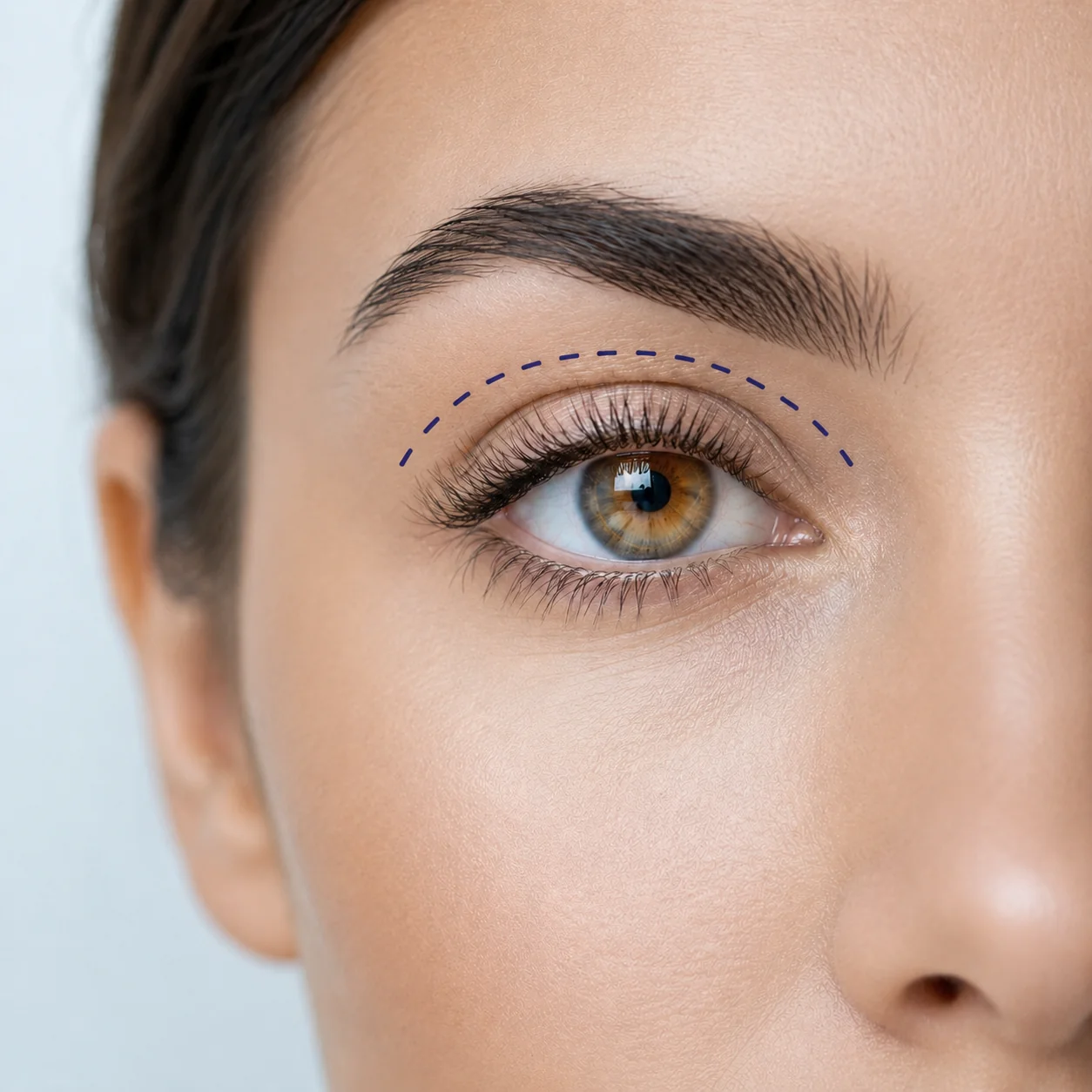
Upper blepharoplasty is the surgical removal of excess skin — and sometimes a small amount of fat — from the upper eyelid. As we age, the skin of the upper lid stretches and begins to fold over the eye crease. The surgery removes a precisely measured strip of this excess skin through an incision hidden in the natural eyelid crease. When healed, the incision is essentially invisible. The result is an eye that looks open, rested, and proportional — without changing the shape of the eye itself.
Why Patients Come for This Surgery
Aesthetic Concerns
Looking tired in photographs even when well-rested. Difficulty applying eye makeup because the lid covers the natural crease. A general impression of fatigue or aging that the patient does not feel internally.
Functional Concerns
Heavy upper lids that partially block peripheral vision — particularly when looking up. Discomfort during reading or screen work. In some cases, this functional component qualifies the surgery as medically necessary rather than purely cosmetic.
Combined With Other Procedures
Many patients combine upper blepharoplasty with fox eye surgery (canthoplasty), brow lifting, or rhinoplasty. The eye area rarely changes in isolation; addressing it as part of facial harmony usually produces a more coherent result — whether the patient’s preference is a subtle refresh or a more defined reshape.
A Note on Brow Position
In many patients, what looks like excess upper-lid skin is partly the result of the brow having descended over time. When this is the case, removing skin from the eyelid alone may not give the most lasting result, and in some situations a brow lift performed before — or together with — eyelid surgery is the more appropriate plan. Brow position, lid skin quality, and the relationship between forehead, brow, and lid are all assessed during your consultation, and the plan is built around what that examination shows.
For a fuller explanation of when brow lift should come before blepharoplasty, see our blog article: Brow Lift Before Blepharoplasty: Why the Sequence Matters.
Are You a Candidate
Upper eyelid surgery is appropriate for patients with excess or hooded upper-lid skin — whether this has developed over time or is present from a younger age due to anatomy. There is no fixed age cut-off; some patients have a genetic predisposition to heavy upper lids and benefit from surgery earlier, while others develop laxity gradually over decades. What matters is the examination, your goals, and that you are in good general health with no untreated eye conditions.
Patients with thyroid eye disease, dry eye syndrome, or certain other ophthalmological conditions require additional evaluation before surgery.
The Procedure
Upper blepharoplasty is performed under local anaesthesia with light sedation, or under general anaesthesia for patient preference. The operation itself typically takes around 20 to 30 minutes total for both eyes.
Before surgery, the surgeon marks the precise amount of skin to be removed while the patient is sitting upright. The incision is then made along the natural lid crease, the marked tissue is removed, and the incision is closed with very fine sutures. Thin medical strip tapes are placed over the sutures at the end of the operation to protect and support the closure.
Patients are discharged the same day and are typically able to return to ordinary daily activities within one to two hours of the operation. At the day-7 follow-up, both the strip tapes and the sutures are removed.
Recovery
Most patients experience some swelling and mild bruising around the upper eye area in the first days after surgery, which subsides over the following one to two weeks. Most return to work and social activities within around 7 to 10 days. A subtle settling of the lid continues over the first month, when the result begins to look natural; the final settled result is generally apparent at around six months.
How we follow you through recovery
Across this recovery, we ask every patient to send weekly photos and videos in the first month, then transition to a structured longer-term schedule that continues until we tell you it is no longer needed. Based on what we see, we adjust your guidance — taping, massage techniques, medications, vitamins, or creams — as your healing requires. Patient compliance with this follow-up is part of the surgery, not a finishing touch on top of it.
Frequently Asked Questions
Will the scar be visible?
When the eyes are closed, the scar is faintly visible as a fine line along the natural lid crease. When the eyes are open, most of the scar falls within the natural fold of the crease and is not noticeable; on the outer (lateral) portion of the lid, a very thin line may remain just outside the fold. Where possible, this lateral portion is hidden within the natural crow’s-feet lines that form when smiling. After healing matures, the overall appearance is subtle and not generally noticed in ordinary social interaction.
Is the surgery painful?
Most patients describe the post-operative experience as uncomfortable rather than painful.
Can upper blepharoplasty improve my vision?
If hooded skin is partially blocking your peripheral vision, yes — patients often report a noticeable improvement in their field of view.
Do you assess my brow position as part of the consultation?
Yes. Brow position is one of the first things examined, because in many patients the heavy-lid appearance is partly caused by brow descent rather than excess lid skin alone. The examination determines whether the right plan is upper blepharoplasty alone, or combined with a brow lift.
Related Reading
Brow Lift Before Blepharoplasty: Why the Sequence Matters
Call to Action
If you are tired of looking tired, the first conversation is short, free, and conducted directly with Dr. Aytaç Kılıç via video. Most patients find that what they thought was a complicated decision becomes very clear after a 15-minute consultation.