Patients searching for “rhinoplasty recovery” usually find timelines that are either too optimistic or too generic. “You’ll look great in two weeks!” is the first kind. “Healing takes 1 to 12 months” is the second. Neither of them is particularly useful when you are trying to plan a wedding, a holiday, a return to work, or simply your own expectations.
The truth is that recovery from rhinoplasty follows a fairly predictable pattern, but the pace varies meaningfully from patient to patient — and skin type is the single biggest reason. A thin-skinned patient at month two looks very different from a thick-skinned patient at month two. Both are completely normal. Both can finish with beautiful results. But they get there on different schedules.
This article walks through what actually happens in each phase of recovery, what most patients can reasonably expect, and the differences that matter when your own timeline does not match the timeline you read online.
The First Week — The Phase That Looks the Worst
Days 1 to 3
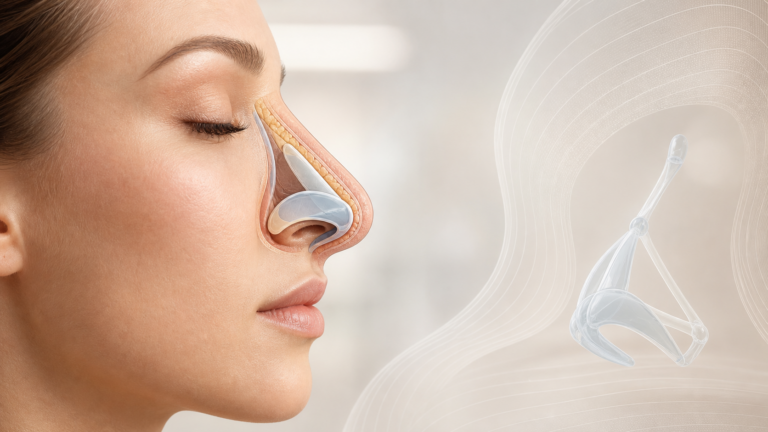
The first three days are the most dramatic in terms of appearance. Swelling around the nose and under the eyes is at its peak. Bruising — when it appears — is at its most visible. The internal silicone splints, which support the inside of the nose immediately after surgery, are still in place for the first two or three days, which can make breathing through the nose temporarily difficult. Most patients describe this period as uncomfortable rather than painful — the discomfort comes more from nasal congestion than from the surgical sites themselves.
Sleeping elevated, applying cold compresses around the eyes (not directly on the nose), and avoiding any pressure on the nose are the most important things during this phase. Patients usually take only mild pain medication; most of the early-day discomfort is the congestion rather than pain that needs strong analgesia.
The internal splints come out at day two or three. This is often the moment patients describe as the biggest single relief in the entire recovery — being able to breathe through your nose again, even partially, transforms how the week feels.
Days 4 to 7
By the second half of the first week, the picture changes quickly. Bruising starts fading from purple to yellow-green. Swelling around the eyes settles meaningfully. The nose itself still looks dramatically swollen and bulky compared to what it will eventually be, but this is normal.
The external splint — the protective cast on the bridge of the nose — comes off at day six or seven, depending on how healing is progressing. This is when most patients see their nose without a cast for the first time, and the reaction is often a mix of relief and surprise. The nose looks swollen, often noticeably wider than the eventual result, and the tip is usually elevated higher than it will sit at month six. This is all expected and not a cause for concern.
For international patients who flew in for surgery, this is typically the point at which final examination and flight clearance happen, and the journey home begins.
Weeks 2 to 4 — Looking Like Yourself Again
This is the phase where most patients begin to feel comfortable being seen in public.
Bruising and visible swelling
The remaining bruising usually fades completely within two weeks. Visible swelling around the eyes and over the bridge of the nose continues to subside. By the end of week three, most patients can be seen at a normal social distance without anyone realising they have had surgery — though anyone who knew them well before would notice the change.
Return to work and social life
Office work is generally possible from around day 10 to 14. Patients in public-facing roles — presenting, on-camera work, customer-facing positions — often prefer to wait closer to two to three weeks. Strenuous physical exercise should wait longer; we typically recommend four to six weeks.
The nose still looks “post-op”
It is important to understand that at week three or four, the nose does not look the way it will eventually look. There is still significant swelling, particularly in the tip and in the soft tissue over the bridge. The shape is recognisable but unrefined. Patients who plan major events — weddings, photographs, important social occasions — within the first six weeks should adjust their expectations accordingly.
Months 1 to 3 — The Slow, Quiet Phase
Between the first month and the third month, recovery enters its longest and least visible phase. From the outside, the nose looks broadly settled. From the inside, much is still happening.
What is actually occurring
Approximately 60 to 70 percent of the total swelling resolves during this period. Soft tissues gradually contract over the new framework underneath. The nasal skin envelope begins to settle and conform to the shape it has been given. Subtle asymmetries that were caused by swelling resolve unevenly — one side may look slightly different from the other at month two, and then even out by month three or four.
What patients commonly worry about
This is the phase where many patients become anxious about the result, often unnecessarily. The nose at month two is not the nose at month twelve. Specific worries I hear regularly:
“The tip looks bigger than I wanted.” In most cases, this is residual swelling — particularly common in thick-skinned patients, and it can take many months to fully resolve.
“My nose looks asymmetric.” Some asymmetry during healing is universal, because swelling rarely resolves perfectly evenly. By month six, most of it has settled.
“It does not look the way I expected.” Final results take time. Comparing month-two photographs to expected outcomes is one of the most common causes of unnecessary distress.
Weekly photographs sent to your surgeon during this period serve two purposes: they allow specific recommendations to be made (taping, massage, topicals), and they let your surgeon reassure you when what you are seeing is a normal stage rather than a problem.
Months 3 to 6 — The Shape Emerges
This is the phase where the nose begins to look like the nose it will become.
Refinement is visible
By month four to five, the broader swelling has resolved sufficiently that the new shape is clearly apparent. The bridge looks settled. The transition between the bridge and the tip becomes more defined. The proportions in profile begin to look final.
The tip is still ahead of the curve in resolving last
The tip is the slowest part of the nose to fully refine. In thinner-skinned patients, it is mostly settled by month six. In thicker-skinned patients, the tip continues to refine well into the second half of the first year, sometimes beyond.
Most patients are happy by month six
For the majority of patients, the result they live with day-to-day is essentially apparent by month six. Final refinement is still happening, but the shape is one most patients would describe as “their new nose.” This is generally when patients start posting photographs and discussing their results.
Months 6 to 12 — The Settling Year
The second half of the first year is where the result stabilises into its long-term form.
Tip refinement continues, particularly in thick-skinned patients
The most consistent feature of this phase is the slow refinement of the tip. Patients with thinner skin generally see all of the tip changes resolve by month nine; patients with thicker skin may continue to see subtle improvements through month twelve and sometimes month eighteen. This is normal and not a cause for concern.
Photographs at month twelve look meaningfully better than month six
Patients who take a comparison photograph at the same angle at month six and again at month twelve are often surprised by the difference. The changes are small enough to miss in the day-to-day mirror check, but the cumulative refinement over six months is substantial.
This is when “final result” becomes a fair description
By month twelve, most patients can fairly describe what they see as their final result. For thick-skinned patients, slight ongoing refinement continues into month eighteen, but the practical experience is of a stable nose at the one-year mark.
Why Skin Type Matters More Than People Realise
If you take one practical point from this article, let it be this: thin-skinned and thick-skinned patients have meaningfully different recovery timelines, and treating both as if they should heal at the same pace causes a lot of unnecessary anxiety.
Thin-skinned patients
Thin skin contracts quickly and shows the underlying framework definition clearly. The advantage is that the result becomes visible relatively early — by month three to four, the shape is largely apparent. The trade-off is that small imperfections in the underlying framework — minor irregularities, edges of grafts — can also become visible through thin skin, sometimes more than thick-skinned patients ever experience. For this reason, planning in thin-skinned patients requires specific attention to camouflage techniques.
Thick-skinned patients
Thick skin behaves differently. It does not contract as easily, holds swelling longer, and takes substantially more time to show the definition of the framework underneath. A thick-skinned patient at month three can feel disappointed because the tip still looks bulky — and then, six months later, look at the same photograph and realise what they were seeing was swelling, not the final shape. The trade-off is that thick skin forgives small irregularities far better, and the long-term result, once healing completes, is often particularly stable.
The most useful thing thick-skinned patients can do during recovery is be patient — and ideally not compare their three-month photographs to thin-skinned patients on social media at the same stage.
A Reasonable Summary Timeline
Putting it all together, the practical expectations for most patients:
Week 1: internal splints out at day 2–3, external splint off at day 6–7, return home for international patients
Weeks 2–4: bruising gone, return to work, social life resumes
Months 1–3: quiet healing phase, swelling reducing, patient anxiety often peaks here unnecessarily
Months 3–6: shape clearly emerging, refinement visible, most patients happy with what they see
Months 6–12: continued refinement, particularly of the tip; this is the settling year
Month 12 onwards: stable result; thick-skinned patients may see subtle refinement continue to month 18
The pace varies. The destination is generally the same.
A Note on Following Up With Your Surgeon
Recovery from rhinoplasty is not a passive process. The small adjustments made during healing — taping recommendations at month two, a different massage technique at month four, an introduction of a particular cream at month six — meaningfully affect the final result.
For international patients, structured follow-up that includes weekly photographs during the first month and a longer-term schedule afterwards is what allows close monitoring without repeated travel. If you have not seen our article on rhinoplasty aftercare, it covers what that follow-up looks like in practice.
The patients with the best results are not always the patients with the easiest surgeries. Often they are the patients who engaged with the recovery process, sent the photographs, applied the recommendations, and allowed the full healing arc to play out.
Frequently Asked Questions
How long does it take to fully recover from rhinoplasty?
The visible recovery — bruising, swelling, return to social life — takes about 2 to 4 weeks. The full settling of the final result takes 12 months for most patients and up to 18 months for patients with thicker skin.
When can I go back to work after rhinoplasty?
Office work is generally possible 10 to 14 days after surgery. Public-facing roles often wait 2 to 3 weeks. Strenuous physical work or exercise should wait 4 to 6 weeks.
When does the swelling go down after rhinoplasty?
Most visible swelling resolves within the first 2 to 4 weeks. About 60 to 70 percent of total swelling is gone by month three. The remaining swelling continues to resolve gradually over the following 6 to 12 months, particularly in the tip.
Why does my nose look bigger than I wanted at month two?
Almost always, this is residual swelling — particularly common in thick-skinned patients. The tip is the slowest area to refine and continues to settle for many months. Comparing month-two photographs to expected final results is one of the most common causes of unnecessary anxiety during recovery.
Is the tip the last thing to heal?
Yes. The tip is consistently the slowest area of the nose to reach its final shape. In thinner-skinned patients, this is largely complete by month six; in thicker-skinned patients, the tip can continue to refine through month twelve and sometimes into month eighteen.
Can I see my final result at three months?
Not really. At three months, the broad shape is apparent but significant refinement is still ahead. The final result is fairly described at month twelve for most patients, with thick-skinned patients continuing subtle changes up to month eighteen.
When can I exercise after rhinoplasty?
Light walking is fine within a few days. Cardio and moderate exercise can usually resume around week three or four. Anything that risks impact to the nose (contact sports, weightlifting with strain) should wait six to eight weeks. Specific timing depends on your individual recovery.
Read Next
- Aftercare for Rhinoplasty in Turkey: What 18 Months of Follow-Up Actually Looks Like
- Does the Nose Tip Drop After Rhinoplasty? A Surgeon’s Honest Answer
- Rhinoplasty in Antalya: What to Expect
Author Bio
This article was written by Op. Dr. Aytaç Kılıç, an ENT and facial aesthetic surgeon based in Antalya. Op. Dr. Aytaç Kılıç completed his medical training at Hacettepe University Faculty of Medicine and his specialty training in ENT — Head and Neck Surgery in Turkey. He gained hands-on surgical experience as a Visiting Student at Harvard Medical School’s Department of Otolaryngology, assisting in advanced facial and reconstructive procedures. His practice in Antalya focuses on primary and revision rhinoplasty, fox eye surgery, upper eyelid surgery, otoplasty, and bichectomy. International patients are a significant share of the practice.
Call to Action
If you have specific questions about how recovery would look for your nose — particularly if you are unsure whether you are thin-skinned, thick-skinned, or somewhere in between — the first consultation is conducted directly with Op. Dr. Aytaç Kılıç via video. Send three photographs (front and both sides), and we can discuss what your specific timeline would realistically look like.
Published May 13, 2026. Reviewed by Op. Dr. Aytaç Kılıç. This article is for educational purposes only and does not constitute medical advice. All surgical decisions are made through individual consultation. Results vary by patient.