A patient I saw recently — about eighteen months out from her rhinoplasty done abroad — came in worried that her tip had started to fall. It was a fair concern. The tip is one of the first things the eye registers when it looks at a nose, and patients are right to wonder whether the work done in surgery actually holds up over the years.
This is one of the most common questions I get asked in consultation. The honest answer involves both surgical technique and what the patient does in the months after surgery. Let me explain both.
Why a Nose Tip Can Drop in the First Place
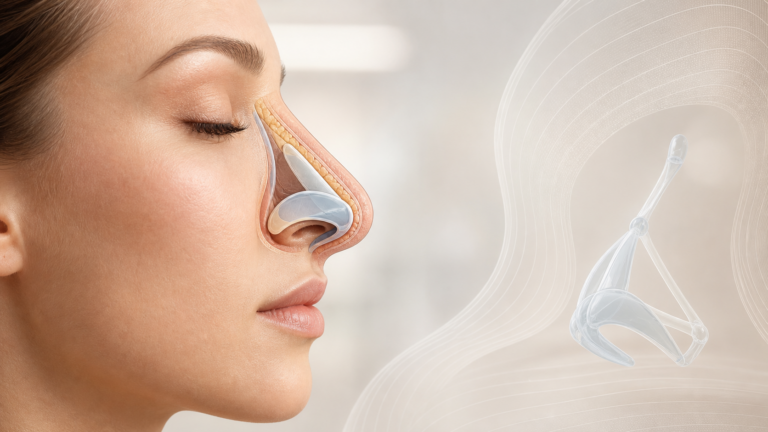
The nose tip is not a single structure. It is held in position by a network of cartilage, ligaments, and the skin envelope sitting on top of all of it. When this support system is weakened — whether by aggressive surgery, poor technique, or simply by the natural pull of gravity acting on heavy tissue — the tip can gradually move downward over months or years.
A few factors matter more than others.
Insufficient support during surgery. The cartilages that hold the tip up need to be rebuilt or reinforced — not just trimmed. In the older style of rhinoplasty, surgeons would remove tip cartilage to refine the shape. The immediate result looked good. But the supporting framework was now weaker than it started, and over time the tip began to lose its position. Modern rhinoplasty has moved away from that approach.
Over-resection of cartilage. Taking too much can produce a sharp, defined tip in the first weeks. But cartilage is what gives the tip its shape and its strength. Remove too much of it, and you have created the conditions for long-term droop.
Heavy skin without proportional support. Patients with thick skin need stronger tip support, because there is more weight pressing down on the framework. I think of it like this: if you have a heavier curtain, you need a stronger rod to hold it up. The same principle applies to the nose. Thick-skinned patients with under-built tip support are the ones most likely to see drop years down the line.
Why the Risk Is Much Lower Today Than Twenty Years Ago
I would say the most important shift in rhinoplasty over the past two decades is the move from reduction to preservation and reinforcement. Rather than thinning the supporting cartilage to achieve a refined shape, we now reshape and strengthen it.
In my own practice, two techniques in particular do most of the work in keeping the tip stable long-term.
Septal extension grafts. A small piece of cartilage — usually taken from the patient’s own septum — is used to extend and strengthen the central support of the tip. This is the structural foundation the rest of the tip work is built on.
Tip suture techniques. These are precise sutures placed in specific positions to shape and stabilise the tip cartilages. Done well, they give the tip both its new appearance and the strength to hold that appearance over time.
When these techniques are used carefully, the result is a tip that is far less likely to drop in the years following surgery, that maintains its shape even as the face naturally ages around it, and that looks aesthetically refined without ever feeling rigid or artificial.
What the Nose Tip Actually Does During the First Year
Patients are sometimes surprised that their tip looks higher than expected in the first weeks after surgery. This is normal, and it is deliberate.
In the early healing period, swelling pushes everything upward. Over the following months, swelling resolves, the soft tissues settle, and the tip gradually finds its final position.
The general pattern I see:
First 1–2 months: the tip looks slightly elevated. This is expected.
3–6 months: the tip starts to settle into its final position.
6–9 months: for patients with thinner skin, the final shape is mostly apparent.
12–18 months: for patients with thicker skin, the full settling can take this long. Tip refinement is the last thing to resolve in rhinoplasty.
The most useful thing a patient can do during this period is be patient. The nose at month three is not the nose at month twelve, and worrying about a result that has not finished forming yet is a common cause of unnecessary distress.
What Patients Can Do to Help the Result Last
The surgeon’s technique determines roughly 80% of long-term stability. The remaining 20% is what patients do after surgery. A few practical points that matter:
Avoid pressure on the nose for the first six months. Sleeping face-down, wearing heavy glasses, leaning on the nose — all of these put downward force on a tip that is still healing. This is the most common patient-side factor in tip drop.
Follow the taping and massage guidance. Different patients need different things during recovery. Some need taping to control swelling in the tip area; others need specific massage techniques to encourage the skin to settle smoothly. This guidance is given based on what we see in your weekly progress photos and is not a generic post-op protocol.
Stay engaged with follow-up. The first six months after rhinoplasty are not passive healing time. They are an active period where small adjustments — a different tape, a different cream, a recommendation to ease off a habit — can meaningfully affect the long-term result.
A Note on What “Natural” Really Means
When I plan the tip in surgery, I am not aiming for the most defined possible result. I am aiming for the most defined result that suits the patient’s face and will still look good in ten years.
A tip that is dramatically refined at month two can look unnatural at month twelve. A tip that is slightly under-corrected at month two often looks exactly right when the full healing is done. This is one of the small judgments that experience teaches you — and it is why I spend the last thirty minutes of every operation reviewing what I have done, looking for anything that might bother the patient or me down the line. Sometimes my theatre team finds this curious. The nose already looks good, they tell me, what are you checking for. The honest answer is: the revisions I am preventing by checking now.
Bringing It Together
If you are early in your research and reading about this concern, here is the practical takeaway.
Tip drop in modern rhinoplasty is largely preventable. The combination of preserving supporting cartilage rather than removing it, using septal extension grafts and precise tip sutures, and matching the technique to the patient’s skin type — these are what produce a tip that holds its position for years, not months.
Your part is just as important. Protecting the nose from pressure in the first six months, following the recovery guidance you are given, and staying engaged with follow-up are what allow the surgical work to do what it is meant to do.
The nose that ages well is the nose that was planned to age well from the beginning.
Frequently Asked Questions
Will my nose tip definitely drop after rhinoplasty?
No — significant tip drop is not a normal outcome of modern rhinoplasty. Some settling is expected as swelling resolves over the first year, but a meaningful loss of tip position points to technique-related issues that careful surgical planning prevents.
How long does it take for the nose tip to settle?
For most patients, the tip settles into its final position between 6 and 12 months after surgery. For patients with thicker skin, full settling can take 12 to 18 months, with tip refinement being the slowest part of the nose to fully heal.
Can tip drop be corrected later if it happens?
Yes, through revision rhinoplasty — though revision surgery is more technically demanding than primary rhinoplasty, and prevention through good initial technique is always better than correction.
Does thick skin make tip drop more likely?
Yes, if tip support has not been built up to match the weight of the skin. The skill in operating on thick-skinned patients lies in using stronger structural grafts to support the framework underneath, so the weight of the skin does not pull the tip down over time.
What can I do as a patient to prevent tip drop?
Avoid pressure on the nose during the first six months — no sleeping face-down, heavy glasses, or leaning on the nose. Follow taping, massage, and recovery guidance closely. Stay engaged with follow-up, because small adjustments during healing can make a meaningful difference to the long-term result.
Read Next
- Rhinoplasty in Antalya: What to Expect
- Revision Rhinoplasty: When and Why
Author Bio
This article was written by Op. Dr. Aytaç Kılıç, an ENT and facial aesthetic surgeon based in Antalya. Op. Dr. Aytaç Kılıç completed his medical training at Hacettepe University Faculty of Medicine and his specialty training in ENT — Head and Neck Surgery in Turkey. He gained hands-on surgical experience as a Visiting Student at Harvard Medical School’s Department of Otolaryngology, assisting in advanced facial and reconstructive procedures. His practice in Antalya focuses on primary and revision rhinoplasty, fox eye surgery, upper eyelid surgery, otoplasty, and bichectomy. International patients are a significant share of the practice.
Call to Action
If you have specific concerns about tip support in your case, the consultation is conducted directly with Op. Dr. Aytaç Kılıç via video. Send three photographs — front and both sides — and we will talk through what is realistic for your anatomy.
Published May 13, 2026. Reviewed by Op. Dr. Aytaç Kılıç. This article is for educational purposes only and does not constitute medical advice. All surgical decisions are made through individual consultation. Results vary by patient.