A patient came to see me last year — a young woman from Manchester, originally of Mediterranean background — who had been told by two different surgeons in the UK that her skin was “too thick” for a rhinoplasty to give her a refined result. She had almost given up on the idea. When I examined her, I told her something different: not that her skin was no problem, but that it was a skin type I see often, that it requires specific techniques to manage well, and that the result she was hoping for was achievable — just with a different approach than the one her previous consultations had described.
This conversation comes up frequently. Thick-skinned patients are sometimes told that surgical refinement is not possible on their nose. That is rarely true. What is true is that thick skin behaves differently from thin skin, and rhinoplasty performed without accounting for that difference often disappoints. Good results in thick-skinned patients depend on understanding what the skin will and will not do, and planning the surgery around that reality.
This article explains why thick skin is technically more demanding, what techniques work, what to realistically expect during recovery, and why the right surgeon for thick-skinned rhinoplasty is one with specific experience in this group of patients.
Why Thick Skin Behaves Differently
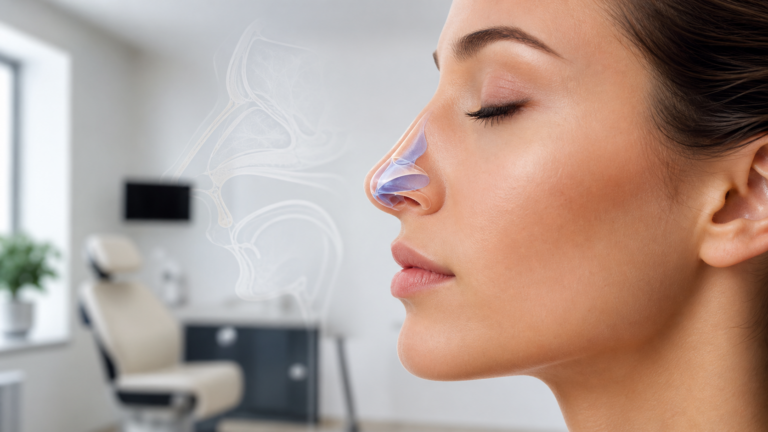
The nose has two main components: the framework underneath (bone and cartilage) and the skin envelope sitting on top of it. The result you see when you look at a finished rhinoplasty is the framework as seen through the skin.
Skin thickness changes everything about how that visibility works.
I explain it to patients this way. Imagine you have a chair with sharp, defined corners and edges. If you drape a thin sheet over it, every angle and edge is clearly visible. If you drape a thick duvet over the same chair, the corners are still there, but they are softer, less defined, harder to see from across the room. The chair has not changed. The covering has.
The nose works the same way. The bony and cartilaginous framework is shaped during surgery — but what you see afterwards depends on what the skin envelope reveals. Thin skin reveals the framework clearly. Thick skin reveals it less, and what shows through is softer, less defined, less crisp.
This is not a problem you can solve by removing more cartilage. In fact, removing more cartilage in a thick-skinned patient is usually exactly the wrong move — it weakens the underlying support without doing anything about the skin that is covering it.
The Surgical Principle for Thick Skin — Stronger, Not Sharper
The mistake in thick-skinned rhinoplasty is treating it like thin-skinned rhinoplasty. Trying to create sharp, defined angles in the cartilage will not produce sharp, defined angles in the appearance — because the thick skin will smooth all of that over from above.
The correct principle is the opposite: build a stronger, more projected framework, so that what shows through the thick skin is well-defined enough to read as a refined result.
In practice, this means a few things in the surgical plan:
Stronger cartilage support, not less. Rather than thinning tip cartilages aggressively, we reinforce them. Septal extension grafts — small pieces of the patient’s own cartilage placed in specific positions — give the tip the projection and definition it needs to push against the heavy skin from underneath.
Camouflage and definition techniques. Specific techniques borrowed from advanced rhinoplasty practice — particular suture patterns, layered grafting, deliberate over-correction of certain features knowing the skin will soften them — are what allow definition to come through. These are technical decisions made during surgery based on the specific anatomy in front of us.
Careful management of soft tissue. In some thick-skinned patients, controlled thinning of the deep soft tissue under the skin (not the skin itself) can allow the new framework to be seen more clearly. This is technique-dependent and not appropriate for every case.
Conservative approach to the dorsum. Over-reduction of the bridge in thick-skinned patients is one of the most common causes of unsatisfactory long-term results. The skin will eventually contract over what is left behind — and if too much was removed, the appearance can become flatter and less defined than the patient intended.
The underlying principle in all of this: in thick skin, more support and more projection is usually the right answer, not more reduction.
What Recovery Looks Like for Thick-Skinned Patients
Recovery from rhinoplasty is not the same for everyone, and skin type is the single biggest reason for the variation. Thick-skinned patients need to know what to realistically expect — particularly during the months when the result feels slow to emerge.
Swelling stays longer
Thick skin holds swelling for longer than thin skin. The bulky appearance of the nose during the first few months — particularly in the tip — is partly the new framework and partly residual swelling that has not yet resolved. The two are easy to confuse when you are looking in the mirror at month two and feeling discouraged.
The shape emerges slowly
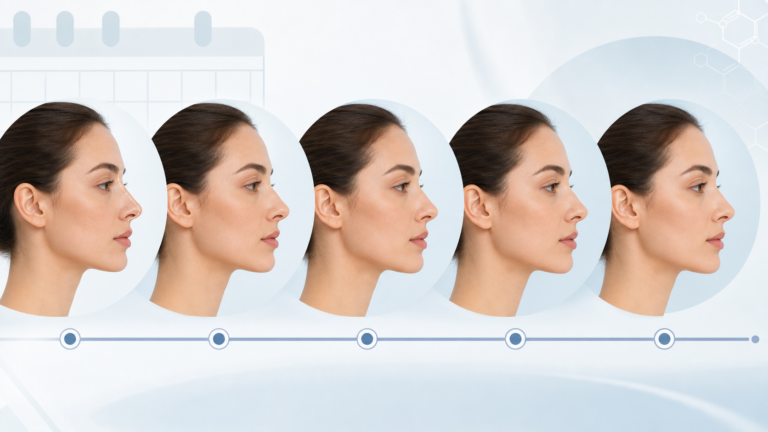
While a thin-skinned patient often has a clearly visible result by month three or four, a thick-skinned patient is generally still in the slow phase at that point. The first time the result looks recognisably like the intended outcome is often around month six. Substantial further refinement continues through month twelve, and in some patients into month eighteen.
The tip is the last area to settle
Across all rhinoplasty patients, the tip is the slowest area to reach its final shape. In thick-skinned patients, this is exaggerated. The combination of heavier skin and a sensitive structural area means tip refinement can be the difference between the nose at month six and the nose at month twelve — visibly significant, but only apparent if you compare photographs.
Active aftercare matters more, not less
This is the most important point. Thick-skinned patients benefit substantially from the small adjustments made during the healing period — specific taping patterns to encourage skin contraction, particular massage techniques applied at the right time, targeted creams or topicals during the slow phase. A patient who engages with structured follow-up will generally see meaningfully better results than one who heals passively. (We cover this in more detail in our article on rhinoplasty aftercare.)
Managing Expectations Honestly
There are some realities about thick-skinned rhinoplasty that need to be discussed openly during consultation rather than discovered six months after surgery.
Definition will be soft, not sharp
Even with excellent technique, thick skin cannot produce the same crispness of definition that thin skin can. The result will be refined, balanced, and harmonious with your face — but it will not look like the dramatic, sharp-cornered results sometimes seen on patients with very thin skin. Trying to chase that kind of definition in a thick-skinned patient leads to over-reduction, which produces worse long-term outcomes, not better ones.
Patience is part of the process
A thick-skinned patient who expects a thin-skinned-patient timeline will be unnecessarily distressed for months. The shape that appears at month three is not the result; the result is what you have at month twelve or eighteen. Going into surgery understanding this changes the entire experience of recovery.
Reference photographs matter
In consultation, the most useful reference photographs are those of patients with similar skin types — not the most dramatic before-and-after pictures circulating on social media (which are often thin-skinned patients photographed in flattering lighting at the moment of peak result). A thick-skinned patient looking at thin-skinned results and assuming the same is achievable on their own face is setting up the wrong expectation from day one.
Why Surgeon Experience Specifically Matters Here
Thick-skinned rhinoplasty rewards experience more than almost any other variation of the procedure. A surgeon who primarily operates on thin-skinned patients may apply the same techniques to thick skin and produce mediocre results — not because of poor surgical skill, but because the case requires a different plan.
What experience in this area produces is the judgment to know which techniques to use in which patient. Examples of decisions that get made specifically for thick-skinned patients:
How much projection to build into the tip, accounting for what the skin will soften over time
Whether to use septal cartilage alone or to plan for additional grafting from another source
How to handle the soft-tissue layer underneath the skin
What recovery support — taping, topicals, massage — the patient will need afterwards
None of these decisions are exotic; they are routine in a practice that sees thick-skinned patients regularly. But they only get made if the surgeon is paying attention to skin type as a primary variable in surgical planning.
The Practical Takeaway
If you have been told that your skin is too thick for rhinoplasty, the honest interpretation is rarely that surgery is impossible. More often it means the surgeon who told you that does not specialise in thick-skinned cases. That is useful information — but it is information about that consultation, not about your nose.
The right surgeon for a thick-skinned rhinoplasty is one who:
Sees thick-skinned patients regularly and discusses skin type as part of the surgical plan
Shows you before-and-after examples specifically from patients with similar skin
Talks openly about what is realistic and what is not, rather than promising specific results
Has a structured aftercare process, because thick-skinned recovery benefits substantially from active follow-up
A thick-skinned patient who finds the right surgeon, has realistic expectations, and engages with the recovery process generally finishes with a result they are very happy with. The path is longer than for thin-skinned patients, but the destination is still a refined nose that suits the face it belongs to.
Frequently Asked Questions
Can I have rhinoplasty if I have thick skin?
Yes. Thick skin is more technically demanding than thin skin, but it is not a contraindication to rhinoplasty. The right approach uses stronger structural support and specific techniques to produce visible definition through the thicker skin envelope. Many thick-skinned patients achieve very satisfying results.
Why does thick skin make rhinoplasty harder?
The skin envelope is what reveals the shape of the underlying framework. Thick skin softens and obscures definition the way a thick duvet softens the corners of a chair underneath. Producing a refined, visible result requires more projection and stronger support — not more cartilage removal — to push the shape through the skin clearly.
How long does recovery take for thick-skinned patients?
Longer than for thin-skinned patients. Visible recovery (bruising, broad swelling) is similar — about 2 to 4 weeks. But final settling of the shape takes 12 to 18 months in thick-skinned patients, with the tip in particular continuing to refine well into the second half of the first year.
Will my result look as defined as a thin-skinned patient’s result?
No, and this is important to understand. Thick skin softens definition no matter how skilfully the surgery is performed. The result will be a refined, harmonious nose — but the sharpness of edges and angles will be softer than in a thin-skinned patient. Trying to chase thin-skin definition by removing more cartilage is one of the most common causes of poor long-term outcomes.
Should I avoid surgery if my skin is very thick?
Not necessarily. What matters is whether the surgeon you choose has experience with thick-skinned cases and a plan tailored to your anatomy. A thick-skinned patient operated on by a surgeon who specialises in thin-skin techniques may indeed have a poor result. The same patient operated on by a surgeon with thick-skin experience often does very well.
What can I do to help thick-skinned recovery go well?
Engage with structured aftercare. The small adjustments made during the months after surgery — taping, massage techniques, targeted topicals — have particular value for thick-skinned patients, because they help the skin contract and the framework become visible. A thick-skinned patient who follows the recovery process actively generally finishes with a noticeably better result than one who heals passively.
Read Next
- Does the Nose Tip Drop After Rhinoplasty? A Surgeon’s Honest Answer
- Rhinoplasty Recovery Week by Week: A Realistic Timeline
- Aftercare for Rhinoplasty in Turkey: What 18 Months of Follow-Up Actually Looks Like
- Rhinoplasty in Antalya: What to Expect
Author Bio
This article was written by Op. Dr. Aytaç Kılıç, an ENT and facial aesthetic surgeon based in Antalya. Op. Dr. Aytaç Kılıç completed his medical training at Hacettepe University Faculty of Medicine and his specialty training in ENT — Head and Neck Surgery in Turkey. He gained hands-on surgical experience as a Visiting Student at Harvard Medical School’s Department of Otolaryngology, assisting in advanced facial and reconstructive procedures. His practice in Antalya focuses on primary and revision rhinoplasty, fox eye surgery, upper eyelid surgery, otoplasty, and bichectomy. International patients are a significant share of the practice.
Call to Action
If you have been wondering whether your skin type allows for the kind of result you are hoping for, the first consultation is conducted directly with Op. Dr. Aytaç Kılıç via video. Send three photographs (front and both sides), and we can talk through what is realistic for your specific anatomy and skin type.
Published May 13, 2026. Reviewed by Op. Dr. Aytaç Kılıç. This article is for educational purposes only and does not constitute medical advice. All surgical decisions are made through individual consultation. Results vary by patient.