If you are reading this, you are probably somewhere in the middle of researching rhinoplasty in Turkey. You have seen the photographs, you have heard the price differences, and you are now trying to work out whether what you are looking at is the right decision — and how to tell a good clinic from one that is mostly marketing.
I am going to do something here that goes against the usual marketing instinct, which would be to convince you that any clinic doing rhinoplasty in Turkey is a good clinic. The reality is more uneven than that. There are excellent practices in Turkey, performing rhinoplasty to a standard that competes with anywhere in the world. There are also clinics where the experience falls noticeably short — particularly in the months after surgery, when patients have flown home and their access to the surgeon evaporates. Both of these realities exist, and what separates one from the other is rarely visible from a website or an Instagram feed.
This article is a checklist of twelve questions I would want a patient to ask before committing to surgery with anyone, including me. Some of them are clinical. Some of them are about logistics. None of them are about price, because price alone tells you almost nothing useful about whether a clinic is right for you.
Section 1 — Questions About the Surgeon
These first four questions are about the person who will actually operate on you. Anything else matters less than this.
1. Who exactly will be performing my surgery?
This sounds obvious, but in many clinics it is not. Some operations are arranged through a coordinator or agency that does not specify which surgeon will do the procedure — sometimes you find out only after arriving. A reputable practice will name your surgeon at the first consultation and that name will not change.
What to look for: a clear answer with the surgeon’s name, qualifications, and direct involvement from consultation through surgery to follow-up.
2. What are the surgeon’s qualifications and how much rhinoplasty do they do?
A board-certified surgeon with specific training in rhinoplasty is not the same as a general plastic surgeon or a cosmetic doctor doing nose surgery occasionally. Volume matters. A surgeon who performs rhinoplasty regularly — week after week, on patients with different anatomies and goals — develops the judgment to handle the cases that do not fit the textbook.
What to look for: specialty board certification (in Turkey, by the relevant Turkish specialty board), confirmation that rhinoplasty is a central part of the practice rather than an occasional procedure.
3. Will I speak to the surgeon during the consultation, or to a coordinator?
Consultation by coordinator is a sign of a high-volume operation where individual planning is rushed. Consultation by the actual surgeon — even if it is a video call — means the person making decisions about your face has seen your face and talked with you directly.
What to look for: a direct video consultation with the surgeon, preferably before any commitment or deposit is requested.
4. Can the surgeon show me before-and-after examples of patients with anatomy similar to mine?
Anyone can show their best before-and-after photographs. What matters is whether they can show you results on patients whose starting point looked like yours — same skin type, same proportions, similar concerns. A surgeon who shows you results on thin-skinned patients when you have thick skin is selling you something the photographs do not actually represent.
What to look for: specific examples relevant to your case, with honest discussion of what is and is not achievable on your specific anatomy.
Section 2 — Questions About the Surgical Plan
These four questions are about whether the surgical plan being proposed is right for your specific nose.
5. What does the surgeon think is realistic for my nose specifically?
Generic answers are a warning sign. “You’ll be very happy with the result” is not a clinical opinion — it is reassurance. A surgeon engaging with your case specifically will talk about your skin type, your underlying framework, what is straightforward in your anatomy, what is more challenging, and how the techniques they use match your particular case.
What to look for: case-specific discussion that mentions your anatomy by name. If everything the surgeon says could apply to any patient, that is information.
6. Is the surgeon planning to address breathing as well as appearance?
Many patients have functional concerns alongside aesthetic ones — a deviated septum, blocked airways, valve collapse — and may not realise the rhinoplasty operation can address both. A surgeon who never asks about your breathing is treating only half of the nose. As an ENT surgeon, I evaluate function as carefully as appearance, but this approach is not universal.
What to look for: questions about your breathing during the consultation, and a clear plan for any functional issues identified.
7. What surgical approach is being recommended, and why?
Open rhinoplasty versus closed rhinoplasty versus preservation rhinoplasty — these are different techniques with different applications. The right answer for you depends on what your nose actually needs, not on which technique the surgeon happens to prefer. Be wary of any clinic that uses the same approach on every patient.
What to look for: a clear explanation of which technique is being recommended in your case, why it suits your anatomy specifically, and what the alternatives would be.
8. What are the risks specific to my case?
Every surgery has risks. A surgeon who lists only generic risks (“infection, bleeding”) is reading from a script. A surgeon engaging with your specific situation will mention what your skin type means for the recovery, what your particular anatomy makes harder or easier, and what realistic complications you should be aware of.
What to look for: specific, individualised discussion of risk rather than generic disclaimers.
Section 3 — Questions About Aftercare
These four questions are the ones that distinguish a clinic where surgery is the product from a clinic where the patient outcome is the product. They are also the most under-asked questions in rhinoplasty consultation.
9. What does follow-up look like for the next 12 to 18 months?
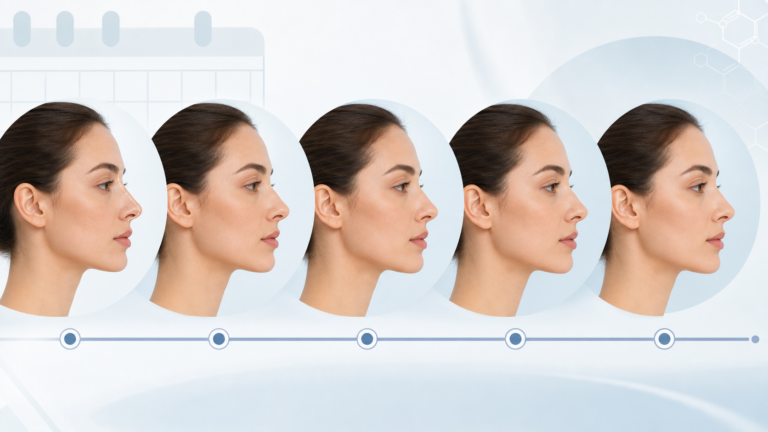
The rhinoplasty result is not finalised on the day of surgery. It evolves over 12 to 18 months, and meaningful adjustments are made during that period. A clinic without a structured follow-up plan is providing surgery, not a complete service.
What to look for: a clear description of the follow-up rhythm — when and how often you will communicate with the clinic, who will review your progress, and what specific recommendations are likely to come at different stages of healing. (We cover this in detail in our article on rhinoplasty aftercare.)
10. Will the surgeon personally review my progress, or only a coordinator?
Day-to-day communication being handled by a patient-care team is fine — in fact, it makes the response faster across time zones. But clinical decisions need to be made by the surgeon. If your progress photographs at month four are reviewed only by a coordinator with no clinical input from the surgeon, the system is not functioning as aftercare; it is functioning as customer service.
What to look for: explicit confirmation that the surgeon reviews clinical material throughout the follow-up period.
11. What is the plan if I have a complication or concern after I fly home?
Complications from rhinoplasty are uncommon but not impossible. The question is not whether they can happen but what the plan is if they do. Clinics with a thoughtful approach will explain how concerns are evaluated remotely, what triggers a request for in-person review, and how they coordinate with UK or local providers if needed.
What to look for: a clear, practical plan rather than vague reassurance.
12. How easy is it to reach the clinic if I have a question?
Communication is the foundation of remote aftercare. Some clinics respond to international patient messages within hours; others take days. Some have a single point of contact; others bounce you through multiple people. The patient’s experience nine months after surgery depends heavily on this practical detail.
What to look for: a clear understanding of how messages are received, who responds, and within what timeframe.
A Note on Price
You may have noticed that none of the twelve questions above are about price. That is deliberate.
Price is the first question many patients ask, often because it is the easiest to compare across clinics. But price is also the question that tells you least about whether a clinic is right for you. Two clinics charging the same amount can offer dramatically different experiences. One clinic significantly cheaper than another may be charging less because the aftercare is minimal, not because they are offering a better deal.
The clinics worth considering should be transparent about what is included in their package — the surgery itself, hospital stay, hotel, transfers, follow-up communication, any further consultations or procedures if needed. The right comparison is between total experiences, not between headline prices.
If price is being used as the primary marketing tool, that is information. The clinics that lead with surgical philosophy and aftercare structure are usually the ones where the patient experience matches what is advertised.
How to Use This Checklist Practically
The point of these twelve questions is not to interrogate every clinic with all of them in one consultation. It is to know what good answers sound like, so that when you have several consultations and try to compare them, you can tell which clinic is engaging with your case substantively and which is reading from a script.
A few practical suggestions:
Write down your specific concerns before the consultation. Anatomy, function, recovery worries, social timing — whatever is on your mind. Bring them to the conversation rather than trusting yourself to remember.
Compare answers between consultations. Patterns emerge quickly. A clinic that gives one generic answer where another gives a detailed, anatomy-specific one is telling you something about what your experience will be.
Trust the consultation that does not feel like a sales pitch. A surgeon who turns patients down when they are not the right candidate is more likely to deliver good results when they do operate. A clinic that closes every patient who walks through the door has a different incentive structure.
Ask the same question to two different clinics. Sometimes the most revealing comparison is hearing the same question answered two different ways.
A Final Practical Point
The patients who finish rhinoplasty with the best experiences — both the result and the journey — are usually not the ones who chose the cheapest clinic, the most heavily marketed one, or the one with the most aggressive social media presence. They are the patients who took the time to research, asked specific questions, and chose a surgeon who engaged with their case as an individual.
There is no shortcut to this process. But there is also no need to make the decision under pressure. Anyone pushing you to commit before you have had time to evaluate the consultation properly is not acting in your interest. The right clinic will give you time. The right surgeon will welcome your questions. And the right answer for your specific case is one that comes from honest assessment, not from marketing material.
Frequently Asked Questions
Is rhinoplasty in Turkey safe?
Rhinoplasty in Turkey can be very safe — when performed by a qualified, specialty-trained surgeon at an accredited hospital, with proper anaesthesia and post-operative care. The variation in safety between Turkish clinics is substantial, which is why the questions in this checklist matter. Safety is determined by the specific clinic and surgeon you choose, not by Turkey as a country.
What is the most important thing to ask a rhinoplasty surgeon?
If there is one question that distinguishes the substantive clinics from the marketing-driven ones, it is “what does follow-up look like for the next 12 to 18 months?” The answer reveals whether the clinic considers your outcome to extend beyond the day of surgery — which is the question that determines your long-term result more than any other.
Should I trust before-and-after photographs on social media?
Photographs are useful but limited. The most flattering images are often selected from the strongest results, photographed in optimal lighting, and shown at the peak of swelling resolution. Ask to see results from patients whose starting anatomy resembles your own, and ask about the typical range of outcomes, not just the best ones.
How do I know if a clinic offers real aftercare or just marketing language?
Specifics distinguish real aftercare from marketing. A clinic that says “we offer 12 months of aftercare” is using marketing language. A clinic that explains “you’ll send weekly photographs in the first month, the surgeon reviews them and adjusts your taping or massage recommendations, and the schedule transitions to longer-term check-ins until the result settles” is describing an actual process.
What is a fair number of consultations to have before deciding?
Most patients benefit from at least two consultations, even if they are leaning towards one clinic. The comparison sharpens your understanding of what is being offered. There is no penalty for taking the time to make a considered decision — and any clinic that pressures you to commit immediately is not the right clinic.
Does it matter if the surgeon is an ENT specialist or a plastic surgeon?
Both backgrounds can produce excellent rhinoplasty surgeons; the relevant factors are specific rhinoplasty training, volume, and experience. ENT surgeons typically bring deeper familiarity with nasal function and breathing; plastic surgeons typically have broader facial aesthetic training. What matters most is the surgeon’s specific focus on rhinoplasty as a procedure, regardless of their primary specialty board.
How long after surgery can I expect to be in contact with my surgeon?
In a well-organised practice, structured follow-up runs for approximately 18 months, with weekly contact in the first month and a longer-term schedule afterwards. This is what allows international patients to receive the same level of monitoring as local patients without repeated travel.
Read Next
- Aftercare for Rhinoplasty in Turkey: What 18 Months of Follow-Up Actually Looks Like
- Rhinoplasty Recovery Week by Week: A Realistic Timeline
- Does the Nose Tip Drop After Rhinoplasty? A Surgeon’s Honest Answer
- Thick Skin Rhinoplasty: Why It Needs a Different Approach
- Rhinoplasty in Antalya: What to Expect
Author Bio
This article was written by Op. Dr. Aytaç Kılıç, an ENT and facial aesthetic surgeon based in Antalya. Op. Dr. Aytaç Kılıç completed his medical training at Hacettepe University Faculty of Medicine and his specialty training in ENT — Head and Neck Surgery in Turkey. He gained hands-on surgical experience as a Visiting Student at Harvard Medical School’s Department of Otolaryngology, assisting in advanced facial and reconstructive procedures. His practice in Antalya focuses on primary and revision rhinoplasty, fox eye surgery, upper eyelid surgery, otoplasty, and bichectomy. International patients are a significant share of the practice.
Call to Action
If you are starting your research and want to begin with an unhurried consultation where the conversation is led by the surgeon rather than a coordinator, the first call is conducted directly with Op. Dr. Aytaç Kılıç via video. The consultation commits you to nothing — its purpose is to assess whether your goals are realistic for your anatomy and whether this practice is the right fit for you.
Published May 13, 2026. Reviewed by Op. Dr. Aytaç Kılıç. This article is for educational purposes only and does not constitute medical advice. All surgical decisions are made through individual consultation. Results vary by patient.